
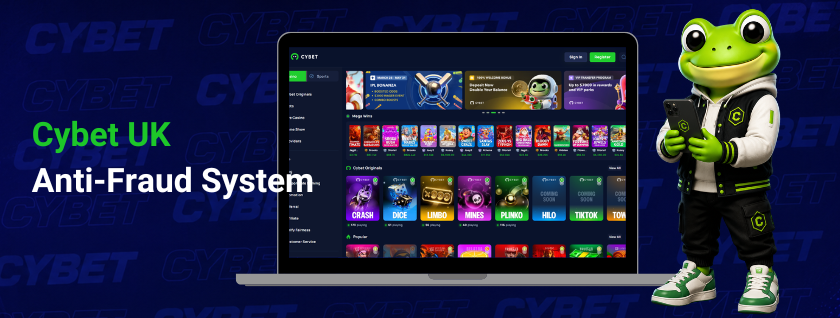
A multi-layered security framework at the Cybet Online Casino protects player accounts, transactions, and personal data. The anti-fraud program employs encrypted connections (TLS/HTTPS), two-factor authentication (2FA), and on-chain crypto processing to maintain a secure gaming environment. Every stage of user interaction — from registration and login to deposits, gameplay, and withdrawals — falls within the scope of this protection. The system detects, prevents, and responds to suspicious activity while ensuring that both new and experienced players engage with their accounts without unnecessary friction.
Fraud Prevention Strategy
Proactive risk reduction measures define the prevention layer within the anti-fraud system, aiming to neutralize threats before suspicious activity materializes. Multiple security tiers protect user accounts and financial operations across all twelve supported digital assets, including Bitcoin, Ethereum, Tether, and USD Coin.
| Prevention Layer | Function | Implementation |
| Account Security | Protects user access credentials | Email verification, 2FA via Google Authenticator |
| Transaction Security | Secures deposit and withdrawal operations | On-chain blockchain processing, TLS/HTTPS encryption |
| Withdrawal Verification | Prevents unauthorized fund transfers | Email and 2FA confirmation, manual review for high-value requests |
| Access Control | Identifies unauthorized login attempts | IP monitoring, device fingerprinting, geolocation tracking |
Only an email address is required at registration, keeping the process accessible for new users. The infrastructure monitors each account from the moment of creation. Repeated failed login attempts or abnormal access patterns automatically trigger security alerts, temporary account restrictions, and additional verification requests. Operations above certain withdrawal thresholds or flagged by risk algorithms undergo manual review before processing. This layered approach balances straightforward user access with effective protection against account takeover, unauthorized withdrawals, and identity-based fraud schemes.
System Architecture
Multiple operational tiers compose the security architecture of the anti-fraud program, each handling a specific domain of threat mitigation.
| Tier | Responsibility | Core Technology |
| Encryption | Data protection during transmission | TLS/HTTPS protocols |
| Authentication | User identity verification | Email verification, Google Authenticator 2FA |
| Blockchain Processing | Transparent fund management | On-chain transaction processing, network confirmations |
| Behavioral Analysis | Anomaly pattern recognition | IP/device/location monitoring, session profiling |
| Manual Review | High-risk case escalation | Analyst review, compliance verification |
All tiers operate in parallel, sharing flagged events across the stack for coordinated response. Deposits and withdrawals processed on-chain benefit from blockchain confirmations, providing an immutable transaction record. The authentication tier enforces email verification at registration and supports optional 2FA for login and withdrawal actions. Behavioral analysis runs continuously, comparing current session parameters against established user patterns. Deviations — access from an unrecognized device, a different IP range, or an unusual geographic region — trigger escalation protocols. Based on operational assessment, this tiered structure allows rapid threat isolation: flagged events are either resolved through automated verification prompts or routed to the manual review tier, where analysts evaluate each case against security and compliance criteria before authorizing further account activity.
Fraud Detection Methods
Automated algorithms and rule-based triggers work together across the platform to identify potentially malicious activity during user sessions and transactions.
Key detection mechanisms include:
- IP and device fingerprinting — each login session records the user’s IP address, browser configuration, and device identifiers. Sudden changes in these parameters flag the session for review.
- Geolocation analysis — access attempts from restricted regions (Mainland China, Taiwan, Hong Kong, Macau, Singapore) are automatically blocked per platform policy.
- Login behavior monitoring — repeated failed authentication attempts, rapid account switching, or concurrent sessions from multiple locations trigger temporary restrictions and verification prompts.
- Transaction pattern analysis — withdrawal requests deviating from a user’s established deposit-to-withdrawal ratio or exceeding normal thresholds are flagged for manual verification.
- Multi-account detection — shared device fingerprints, overlapping IP addresses, or similar behavioral patterns across accounts indicate potential bonus abuse or coordinated fraud.
A centralized risk-scoring engine aggregates results from each mechanism. Accounts accumulating risk indicators above a defined threshold are automatically restricted pending verification. Identity document requests (KYC) may follow when fraud indicators persist, even though the Cybet UK platform generally operates as a no-KYC-friendly service for standard gameplay.
Real-Time Monitoring
Continuous surveillance of all account activity, transaction flows, and session behavior provides the monitoring backbone of the anti-fraud framework.
Core monitoring capabilities:
- Live session tracking — active sessions are analyzed for behavioral anomalies, including unusual navigation patterns, rapid bet placement, or automated script-like interactions.
- Transaction surveillance — every deposit and withdrawal is tracked against the user’s historical activity profile. Deviations from established patterns generate automated alerts.
- Withdrawal queue management — pending withdrawal requests pass through a risk assessment layer before entering blockchain processing. High-value or anomalous requests are held for analyst review.
- Alert escalation pipeline — automated alerts are categorized by severity, with critical flags routed immediately to the security team for human assessment.
- Cross-session correlation — data from multiple active sessions is compared to identify coordinated activity, such as synchronized betting patterns or deposit timing across linked accounts.
The final security check occurs during the blockchain confirmation window, which typically spans several minutes to one hour for digital asset withdrawals. On-chain transaction processing ensures a transparent and verifiable record for every completed crypto operation on the platform.
Compliance and Audit Layer
Regulatory alignment and structured audit processes form the backbone of the anti-fraud infrastructure, ensuring that security measures meet licensing requirements and responsible gaming standards.
Key compliance components:
- Licensing framework — the platform operates under the Anjouan Offshore Finance Authority license (ALSI-202409034-FI2), which mandates specific security protocols and player protection measures.
- AML procedures — transaction monitoring includes checks for patterns consistent with money laundering, such as rapid cycling of deposits and withdrawals without proportional gameplay activity.
- KYC escalation protocol — while routine access remains document-free, identity verification may be requested when abnormal login activity, suspected fraud, or AML triggers are detected.
- Underage gambling prevention — accounts belonging to individuals under 18 are immediately suspended, winnings forfeited, and access permanently revoked.
- Self-exclusion integration — the responsible gambling program features a two-step process: a 24-hour cooldown followed by extended exclusion periods (1 day to permanent). This mechanism restricts account manipulation during cooling-off periods and serves both player welfare and fraud prevention.
- Audit trail maintenance — on-chain records and internal system logs create a tamper-resistant audit trail available for regulatory review at any time.
Periodic internal reviews assess system performance against defined security benchmarks and compliance standards.